Showing posts with label MLR. Show all posts

Sunday, January 24, 2010

The Big One!

Bless them boys, Who Dat! and Geaux Saints! As someone that spent most of my life in Louisiana, the Saint's getting to the Superbowl feels like an impossible dream that just came true. As someone who lived in New Orleans most of my adult life, who watched from afar after moving away from Louisiana the city that was the state's most visible symbol destroyed by the "big one," that no one thought would come seeing the Saints eligible to play in the "Big Game," that again, no one thought would come, seems surreal. In New Orleans before Katrina, the newscasts would advertise for hurricane preparedness, asking proverbally "what if the big one hit New Orleans." Well it did, and the city has never been the same. For many, the New Orleans Saints represented a break from the reality of mold covered homes and lost possessions -- a way to forget that the city they loved was now forever marked by the eye of a perfect storm, that destroyed lives, houses, and hopes. No symbol was more emblematic than the Superdome -- a building whose exterior mirrored the cities pain for so long.

Tonight's game was bigger than football. It seemed to confirm that the past is over. And maybe that's ok. In New Orleans, the past, before Katrina seemed ideal. It was the after-Katrina world that was so scary. But tonight's win in the same dome where people's lives in the city were forever changed, maybe offers a glimmer of hope. Perhaps the future can be better than the past was. The past was filled with inequality and political cronyism. Maybe that has not changed, but with every new day lies new hope. The Saint's showed that the future does not have to be worst than the past.

In reality, the last few minutes of the game seemed to encapsulate the Saint's and New Orleans' history. The Saint's offense seemed more like the aints' after the first half; the defense gave up first downs and big plays; and the season seemed like so many others of late -- lots of promise, but just short of the big one. And then, as if by divine intervention, the Big Ones came -- the biggest interception; the biggest forty-yard kick-off return; the biggest fourth and inches conversion, and the biggest forty-yard field goal; and, perhaps, the biggest win that the team and the city of New Orleans needed. The future is bright. The only thing I think I can say to match my thoughts -- Bless them Boys! And Geaux Saints.

And now, pulling a trick from Dean Chen's book, I can think of no better song to offer you than U2 and Greenday's The Saints are Coming

Marc (MLR)

Monday, December 7, 2009

Commercial Law Course Survey Update

I have received 70 responses so far. Once again, I am only reporting the raw numbers to this point, so the percentages reflect the number of times the course option was selected as against the other options (including write in variations). I also include a list of institutions in which someone has posted a response, so if your institution is not represented, please take two minutes to complete the survey by clicking here.


Thanks
Marc (MLR)

Wednesday, November 18, 2009

Commercial Law Offerings

I am doing a quick curriculum survey of commercial law offerings at various schools in an effort to see how commercial law courses are taught in a variety of configurations. The survey is only two questions long and will require less than a minute of your time (maybe less than two minutes -- but I offer no warranties as to the time). Please click the link, identify your school and check all of the boxes that apply to your institution regarding the commercial law courses offered by your school. And for those curious as to the overall results, I will post results as they come in updating as appropriate. I will not post by school, but rather will likely group the results according to tiers or by overall group size.

Marc (MLR)

Wednesday, September 16, 2009

From the World of Law Reviews: Game Theory and Law Review Submissions

As the height of the law review submission season is coming to a close, I thought I would observe an interesting approach by a law review editorial board and some other general observations.
Law Reviews Gaming it Up. The editors at the University of Cincinnati Law Review, who will ultimately publish my piece on fixtures Groping Along between Things Real and things personal, engaged in a nice piece of behavioral prediction in making the offer to publish. In the offer letter the editors offered two choices: (1) I could expedite with anyone over the next two days; or (2) I could expedite with only the top 30 law reviews over the next 10 days. This strategy is genius from the law review editor standpoint. First, its highly likely that the reviews most likely to take the piece out from under Cincinnati are those ranked between 31 and 51. The strategy by Cincinnati reduces to almost near absurdity the time frame for journals to respond. On the
other hand, if they are likely to lose an article to a top 30 journal, then 10 days will likely not be needed for that decision to reveal itself. This is the kind of law review gamesmanship that I like and support! Has anyone else seen an offer like this before?
Lex Opus is a good secondary alternative to Bepress's Expresso. In some ways, the system operates just a smoothly. Another feature that I liked was Lex Opus allows law reviews to view the work sua sponte and make the author an offer -- I received one offer that was not unattractive. That seems to me to be a pretty good idea and, though I imagine that such offers are rarely accepted, it is still a nice feature. But the best feature is its cost -- its free.
Peer Review of General Law Review Articles. Brian Leiter this morning posted a link to PRSM -- A consortium of law reviews engaging peer review processes. Journals that have signed on to the consortium include The South Carolina Law Review, The Mississippi Law Journal, Stanford Law Review, and the Wake Forest Law Review. It will be curious to see if this is successful.


Marc (MLR)


Friday, July 31, 2009

Does the way we transfer money indicate a turn in the economy?

Since 1987, the volume of transactions on FEDWIRE have consistently exceeded the volume of transactions on CHIPS. This is not necessarily unexpected. FEDWIRE handles, according to the Comptroller's Handbook one-third of its volume as federal funds transactions and one-fourth of its activities as securities transactions. Another significant source of transfers are those between Federal Reserve Banks, which would naturally include certain mortgage funds. Naturally, the volume of these transactions probably should be higher. On the other hand, CHIPS primarily deals with foreign-exchange transactions (nearly 1/2 of the dollar value. Another 1/3 of the dollar value is Eurodollar placements.

See Chart showing Number of Transfers

However, over time, the value of these transactions has changed. Consider that in 1987, the amount transferred on Fedwire was slightly higher than that transferred via Chips.


From 1987 until 1998, the amount of money transferred via Chips exceeded that on Fedwire by a maximum of 28.51% difference in 1994. Beginning in 1995, however, the amount of money transferred on Fedwire began inching closer to that on Chips, and in 1998 exceeded the amount of money transferred on Chips. After 1998, the amount of money transferred on Fedwire has exponentially grown reaching a high in 2008 of a 32.61% differential; the only two years in which the growth pattern was not consistent was 2006 and 2007, and even then, the differentials were the third highest differential (2006) and the seventh highest (2007) of the years between 1988-2008.


As we look at the numbers, I can't help but notice the date similarities to the current economic crisis. For example, consider the following graph provided by Planet Money on the economic crisis charting debt from 1999-2008:


From 2000 to 2003, government borrowing steadily rose, followed by a short decline through 2008, when it suddenly spiked. During that same period, Business lending acted inversely: declining from 2000 to 2003; rising from 2003 to 2007; and suddenly nose-diving in 2008. In fact, in their post titled Charting Debt, the planet money guys point out that early in 2008, Americans simply stopped borrowing.
In another chart, in their post titled Chart: Inflation, not the flu, we see other similarities:


Between 2004 and 2007, we see a drastic drop in inflation. However, beginning again in 2008 and through 2009, we see a drastic rise.
This is what I am wondering. Can we make conclusions about the future of our economy by the way we transfer money now. That is, are the types of transactions reflected on Fedwire and Chips the types of transactions that give us a barometer of the economy. Moreover, is there a healthy balance of reciprocal relationship between the two -- does a substantial amount of transference on one wire service lead to high chances of inflation and higher government spending, with lower consumer activity. A few unknowns in this quest:

1. Are there funds that in certain years appear on Chips that in the last few years have appeared on Fedwire because of the type of transaction. One category of these transactions might be if foreign investment shifted from currency exchange to securities. If so, this might suggest that the way we invest foreign money does matter for the way the economy functions.

2. Are there institutional issues that have resulted in the changes and can we segregate the institutional issues from the non-institutional issues in the rise and drop of value transactions between the two wire services. For example, we know that the institutional controls for lending were significantly more lax between 2000 and 2007. This might explain a high proportion of funds on Fedwire during that period of time.

I am curious for other thoughts -- institutional or economic that might show a correlation between the current economy and the future economy.

Marc (MLR)

Wednesday, June 24, 2009

Congrats to LSU for winning the College World Series

So the tag line is not commercial, but so that the content isn't completely irrelevant, here is an interesting story that was on MSNBC about LSU fans spending money (helping the economy) in Omaha. Now that that's out of the way — Congratulations to my alma mater the No. 1 LSU Tigers for Beating TEXAS for the College Baseball National Championship. Geaux Tigers!
Picture from ESPN front page.
Marc (MLR)

Wednesday, June 3, 2009

Virtual Payment Systems

The Financial Times is reporting that Facebook will unveil soon its Facebook currency. Here is a link to the article.  Of course Facebook is not alone in creating its own currency.  Second life has used Lindens, which can be exchanged on an open market for U.S. Dollars.  There was also in 2007 the Liberty Currency featuring the Ron Paul Dollar.  In 2007 the FBI raided the Liberty Dollar Currency office and gathered as evidence all of the Gold and Silver from the Liberty Office.  

Saturday, April 25, 2009

Bankruptcy Commercials

Lawyer advertising has always received a bad rap. Its hard enough to tell whether lawyers are capitalizing on people's misfortunes when charging clients to sort out their problems (I don't have a problem with charging clients, but I do recognize the perception outside of business circles that lawyers make money on the heels of tragedy). That being said, I don't know how you produce a "classy" commercial. If you use empathy, it just looks shallow -- i.e. the single mom at a table with a stack of bills at 2:00 in the morning and the voice over of someone that sounds like a televangelist talking about no hope, and "there's a way out." If you try a business approach, you just look like a non-caring SOB that is going to get paid -- i.e. two attorneys posing, usually in front of bookshelves, sitting 3/4's on a desk, or some other office setting, and telling you "you have rights," (by the way that we will convert into dollars in our pocket). I point this out because I am not really sure what to do with this one. Is it anger, comedy, both or neither?


Here is another.


Marc (MLR)

Thursday, April 23, 2009

iPhones, Kindles, and Digital Rights Management -- When the Sale of Things are not the only things that matter


So I have been thinking of how to talk about (shamelessly plug) my recent work on Apple's iPhone warranty. The article argues that Apple might be better off not litigating its intellectual property rights against consumers and instead using their warranties as a bait to convince consumers to act with good behavior to the iPhone (i.e. not hack it and therefore avoid the service arrangement Apple receives comensation through with AT&T). Last week I wrote a column for the Los Angeles Daily Review in which I said that gateway sales were possibly more important to certain vendors of high end consumer products than the thing itself:
In the high-tech consumer arena, device sales often are the gateway to other profits beyond the sale. Apple receives monthly compensation from AT&T for every iPhone that reaches the AT&T network. X-Box, Sony, and Nintendo reap profits from pay-to-play online gamer services like X-Box Live, Nintendo DSi, and Playstation Network, in addition to the stand alone games they sell in stores. Sony Blueray sells DVD Players -- but is far more interested in selling consumers DVD's from the Sony library. And the recent Amazon Kindle is poised to make a significant dent in the book seller market. Post-sale profits have become such a large factor that some manufacturers value those profits more than those made on the device itself. If those post-sale profits don't materialize, the potential loss for companies like Apple is enourmous -- conservatively between $3 million and $18 million per month for iPhones that never reach the AT&T network.

So how do you entice consumers to act better with their products. One means of doing so has been to "brick" the device so that the cnsumer has no more functional use (or desired use from the product). Hackers use the term brick because to them, the device obtains the value of a brick. Microsoft has been successful in "bricking" users from their x-Box Live accounts for invalid use, by banning user accounts for 7992 years (or until 12/31/9999). And Amazon, most recently terminated a user account for "frequent returns" effectively blocking the user from using his Kindle. Amazon ultimately relented, but the warning was served.

The problem with "bricking" is that it is only a temporary solution until consumers (or another third party) catch up technologically to offer a better use. In fact, the reality is that there are consumers that actually do buy the product to have the product. Consumers that have been bricked will eventually grow weary of paying for new accounts, buying new devices or whatever means the manufacturer has used to keep the user out. Then, those bricks will eventually form cities/ communities of disgruntled dwellers that have the technological knowledge and incentive to find alternative uses for their product, particularly in ways that do not benefit the manufacturer.

The solution I have offered, in both the Duke Law and Technology piece and the L.A. Daily Review, is that manufacturers should reevaluate how they approach these consumers. Indeed, Manufacturers may find better profits by approaching consumers on a negotiated terms basis utilizing things like warranties as enticements. By enticing the consumer to be better stewards of the product, they can probably avoid most hackers (except for those that do so for the pure sport of it).

Over the next few weeks I will say more about the longer piece including the Behavioral Economics Aspect of the article and some other commercial solutions for a not entirely commercial problem.

Marc (MLR)

Tuesday, March 31, 2009

Pawnshops and iPods

Last year, while living in Tulsa my wife and I were broken into and my iPod was stolen. About three months ago, I received a letter from Tulsa PD that my iPimages.jpgod was identified. Pawn shops in Oklahoma have to register all items into a centralized database by serial number (if available); when my iPod's serial number was entered it triggerd a stolen item report to the Tulsa PD. We executed the various affidavits and designated a former student to recover the property. She had to go to court to get an order to recover the property and this is what she said about the process:


Apparently Tulsa releases stolen property once a month. There were about 12 people there wanting to recover. The judge called each name individually…asked if they were there to pick up “x” (mostly GPS’s by the way), whether there was anyone there from “x” pawn shop or if the individual who pawned it was there (there wasn’t for anyone), then said she’d sign the order and to sit down. This took about 15 minutes. Then we were instructed to go to the hallway while we waited for our paperwork. That took about 5 minutes. Then off to the pawn shop (apparently Tulsa does it this way because there’s no room in their property room). The pawn shop, as you know, was in north Tulsa. It was pouring down rain that day so it “wasn’t very busy” (apparently pawn shops are local hangouts). The manager took my paperwork then went looking for it…this took about 30 minutes! I was worried that he had sold it since he kept saying he couldn’t find it. But, after enough searching he found it. It was all wrapped up in cellophane with a City of Tulsa sticker on it stating it was stolen property. He checked my ID and I was on my way. Apparently, if it was a gun that was stolen they have to verify that you can legally be in possession of a fire arm before they can release it.


Pretty much uneventful, but interesting nonetheless.


1-201's Buyer in the Ordinary Course exclusion rule in action! Kudos to Sandy Cooper for braving the pawn shop and the courts to recover my iPod. I am curious what music, if any, is left after sixteen months....

Update Sandy also noted that the pawn broker checked the serial number on the pleadings meticulously, which caused me to remember how we came across the serial number. We contacted Apple Inc. who had the serial number. Even though Apple was more than willing to give us the serial number, they were not willing to let us know who reregistered the iPod. I suppose I can imagine why Apple might not be willing to police its stolen merchandise.


Saturday, March 28, 2009

Southpark's Theological View of the Economic Crisis

Trey Parker and Matt Stone have created a theological view of the economic crisis. Bravo!

Click here to watch SouthPark in a new window.

Marc (MLR)

Tuesday, March 24, 2009

Signs of a Troubled Airline

I am on the road this week looking for houses in Southern California, and one thing struck me on the plane ride. U.S. Air sold advertising space to Zicam on its fold down tables -- ALL OF THEM. Little billboards under your drink as you fly.  Is this just a smart allocation of space or signs of an Airline in trouble? Also slightly troubling, U.S. Air is now charging for WATER, soda, snacks, and of course spirits. I did not see a pay slot for the restroom but perhaps that innovation is not too far away. Are these things signs of desperation that might make you think twice about flying with that airline or is the airline efficiently using its assets.


Marc (MLR)


Friday, March 20, 2009

State Business Court Specialization

judges.jpgToday at lunch, between watching the 1st round NCAA games (Geaux Tigers), we were talking about specialized courts in various fields. For example, there is currently legislation, called the Patent Pilot Program (Senate Bill 299 and House Bill 628) to designate special district court judges as "patent judges." Under the bill, not less than $5,000,000 would be set aside to provide training to judges and staff, and for the hire of specialized law clerks to assist the new "patent judge." This discussion started me thinking about State Commercial Courts. I am wondering what the impact of State Commercial Courts are on decisions to arbitrate by clients. These business courts have been established to create a forum for specialized decision making by tribunals. For example, Maryland's Business and Technology Court Case Management Implementation committee provided for specialized training for judges in handling technology for easing the case burden on certain cases. New York's Commercial Division was created to "improve the efficiency with which such matters were addressed by the court and, at the same time, to enhance the quality of judicial treatment of those cases." Likewise, the North Carolina Business court was specifically created to oversee specialized complex commercial litigation matters.


There are currently sixteen states that have either ventured to create specialized forums for commercial litigation or have entertained the idea in some form. It seems that most of these courts are designed around the complex nature of the litigation, rather than the subject matter; specifically the expertise seems to be handling document intensive litigation. So is business court or commercial court division a misnomer? Do litigants expect that Judges hearing these matters have a greater expertise than an ordinary judge in accounting principles or transactional work. If there is a higher level of expertise in transactional matters, does that have a trickle down impact on negotiating to arbitrate disputes by the parties -- (there may be other reasons for preferring arbitration, like not wanting to risk the resolution of disputes on a jury trial, but putting that aside, does the creation of a specialized forum for business problems alter parties dispute resolution choices?). Do these courts have actual technical commercial expertise, or are they just better at handling document intensive litigations than their district court counterparts. I am curious to hear from anyone that has experience with these courts.


Marc (MLR)


Wednesday, March 18, 2009

The Death of [the] Contracts [Course]... Maybe that's a good thing

The AALS Contracts list-serve two months ago carried a stream of interesting comments around the question whether contracts should be taught in four or six hour blocks of time. These discussions have been brought by the need to inject other things into the first year curriculum, such as skills courses, constitutional law, etc... (which I am all for). However, I want to offer a different proposal than a mere reduction of hours -- maybe we shouldn't teach contracts to first year students at all. Instead perhaps we should teach students in the first semester Article 2 of sales. Here are my reasons, in no particular order of significance. By the way, you can disparage me in person if you are going to the Contracts Panel at SEALS this summer, as this will be the basics of my presentation...


1. Its a Legislative World and I'm a Legislative.... The same argument I consistently hear justifying common law contracts as a First Year Course is that it teaches students how to read cases. First, doesn't Torts, Property, Criminal Law, and Civil Procedure do equally fine jobs of teaching students how to read cases? Second, and more importantly, where in the first year curriculum are we teaching students how to read statutes and Codes. We are not, and as a result, when students come to take a code based course, they repeat their first year growing pains again by by having to learn how to read and analyze statutes. Sales provides a great opportunity to fill the legislative gap and still .....


2. Introduce Students to the basic principles of contracting. Offer, assent, parole evidence, statute of frauds, battle of the forms (of course) impossibility, remedies... Its all there. The difference is two fold: one, the material is in a more concrete format in the form of a code; and two, the material becomes more understandable because students have a familiar and definite context for understanding specific rules like parole evidence, statute of frauds exceptions and the battle of the forms. As I tell my UCC students, we have all bought candy bars by the time we get to law school and we know the essence of the process --I give you money and you give me a Snickers. We now are putting definite terms to that process.


3. Is Common Law Contracts that relevant anymore? Sure the basic principles of offer, acceptance, etc.... in some form stretch the gambit of contracting. But our legal system has created so many different types of contracts that each vary in nuanced ways from each other. Employment contracts are different from sales contracts which are different than construction contracts, which are different from licenses and so on and so on. The idea that we are teaching general principles that stretch through the curriculum falls apart when students learn that each of these different contracts have their own unique language and terminology that renders the common law of contracts at best a quaint introduction to the sport of creating obligations. Add to that fact that much of contracting gets reduced to form-negotiations and contracting as an art becomes mostly irrelevant. If contracting were taught as an exercise in transacting, I believe it would be far more effective. One of the comments from the contracts list-serve discussion that I really appreciated came from Peter Linzer, in which he said:


At a less abstract, but much more practical level, I have for a long time been advocating a shift from Contracts as a course in busted deals to a course in what real contracts lawyers do, advising clients, helping them to plan, and getting the plan on paper through good drafting. I’m still trying to slip a bit of that into my four-credit course, but I can’t really change much. Some parts of Contracts must be taught from the cases (interpretation, the parol evidence rule, remedies, the click-wrap issues (which, of course, are also part of the transactional part of the process)). But the real task of preparing students to be transactional lawyers needs to be taught differently, and can’t be covered well in a four credit course. I can teach a class of 100 how to draft, but I can’t review their work to raise them beyond the very basics. That has to be covered in a more advanced course. But if we can sensitize students to what contract lawyers really do, and the important role of drafting and planning, we can greatly improve the abysmally low level of quality among most business lawyers, especially those dealing with small businesses. That, however, needs much more time than is available in a four hour course.


I concur.


4. Teaching common law contracts does not necessarily prepare students for the bar exam. First of all, students rarely retain what the parole evidence rule is versus the statute of frauds between the end of their contracts course and the beginning of their second year (or they may just deny any knowledge of those things in class). Moreover, we have pretty well ceded bar preparation to Bar-Bri, Mishmash, or what ever other cram course students are willing to fork out $2500 to cram long-forgotten doctrines in their minds. Have we all of a sudden become less confident in bar-review's capacity to teach contract doctrine as well? It seems to me that most professors I talk to vehemently deny that they are teaching for the bar (which I do as well). So why would we teach a course on that basis.


5. For that matter, Sales does not prepare students for the bar exam either, but there is a trickle down effect. In the same way that contracts does not necessarily create a long-term knowledge of contracts doctrines, neither will Sales. Though, at least by teaching sales early, we open the door for other UCC courses to be more accessible to students. Students that take Article 9 or Article 3-4, are more likely to be prepared for courses like bankruptcy, debtor and creditor rights, taxation, and corporations. Getting students in the sales curriculum earlier rather than later aids that process.


6. Wouldn't we all be happier teaching a perspectives-esque upper level course on the theory of contracts. Really isn't that what we all really want to teach anyway. This to me is the best use of the contracts course and one that often gets pushed aside for lack of hours or because students are not quite ready to understand these nuances. This is the art of preparing lawyers: equipping them with the intellectual tools to make rational decisions regarding how contracting should be undertaken. Forcing students to struggle through Law and Economics views of contracting, moral theory of contracting, etc... before they truly understand the contracting process seems to me to be reversed. Students will learn more and professors will be happier with the result.


The only upside to the contracts course is it might make the classic movie, The Paper Chase irrelevant, though I think I can live with that -- I think.


Marc (MLR)
MV5BMTk5MjQ0MTI4Nl5BMl5BanBnXkFtZTcwMzkxNzUxMQ@@._V1._SX77_SY140_.jpg

Good Commercial Faith and the City

Thank you welcoming me into this space to talk out loud about some of the aspects of commercial behavior that I have been thinking of for sometime. I'm delighted to be blogging here. In addition to talking about my article on consumer behavior, I hope to write some on other aspects of consumer decision making. But today, I want to talk about commercial virtues.


One of the troubling aspects of commercial dealings today is the focus on ethics. Truthfully, I despise the topic (perhaps because I was never very good at the subject in either theological classes or law classes -- like professional responsibility for one). But the real reason I despise ethics, my own discordant academic performance in the subject aside, is I think we are often times asking the wrong questions. We assume that by ethics, we mean some form of social responsibility, but more often than not, that responsibility is defined by communities of interest, rather than greater social values. Consider the problem with UCC 1-201 and the definition of good faith. Do we really mean good faith is "honesty in fact" when we combine that with the observation of "reasonable commercial standards of fair dealing". Which takes precedence -- clearly the latter. The secured lender that tells only part of the story to his debtor (your income statement is a mere formality) has not been completely operating with "honesty in fact" though his actions may well fit within the constraint of reasonable commercial standards of fair dealing -- after all, fudging your income was hardly the act of just a few bad apples. The subjective element of good faith gives way to the relevant community that defines what good faith means.


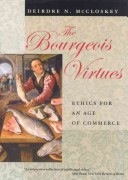
Deirdre McCloskey in her defense of capitalism, aptly named, the Bourgeois Virtues, makes many debatable claims that Capitalism makes the world better books.jpg(many of which I will not attempt to defend). But what McCloskey does get is that commerce (and commercial law) urges the continued development of social structures for the betterment of the individual within a community that is itself working to be better. Quoting Rabbi Starks, McCloskey writes:



It is the market -- the least overtly spiritual of contexts -- that delivers a profoundly spiritual message... The free market is the best means we have yet discovered... for creating a human environment of independence, dignity and creativity.


McCloskey's message of capitalism as a movement of social ingenuity is at its core the spiritual message of hope we find in some of our best religious literature. The prophet Jeremiah admonished the Israelites in Captivity:


This is what the Lord Almighty, the God of Israel says to all those I carried into exile from Jerusalem to Babylon: 'Build houses, settle down; plant gardens, eat what they produce, Marry and have sons and daughters; find wives for your sons and give your daughters in marriage so that they too may have sons and daughters. Increase in number there do not decrease. Seek the peace and the prosperity of the city to which I have carried you into exile. Pray to the Lord for it, for if it prospers, you too will prosper.


Ralph Waldo Emerson also saw that hope comes from capitalist engagement but only wh180px-RWEmerson.jpgen the mind is able to reflect upon its work. Emerson distinguishes between the Brute Economy, in which labor and strength build vast empires of material longing only (i.e. its good to spend money to relieve us of the pain of 911), with the capitalist economy which employs intellect in an analytical expansion of labor, material and wealth. What Emerson says the Capitalist lacks is the moral and spiritual wisdom of the poet - "who acts upon nature with his entire force -- with reason as well as understanding."


The virtue of McCloskey's work is that Commerce (and capitalism) share a common goal of enhancing our social order, instilling the hope that we might reshape "the city" into an image that is not of ourselves as we currently stand, but of the selves that we might one day hope to be, both individually and collectively. And that actions should be weighed and measured against both of these standards. Whether we segregate capitalists from capitalist poets, we nonetheless, come to the same conclusion as Emerson and McCloskey -- that commerce creates the potential for humans to be good.   


Which brings me back to 1-201. Do we really want good faith to be watered down by community constraints or is there a moment for reflection of the aspirational norms that commercial dealings might adhere to? I was much happier when good faith was simply "honesty in fact" without the burden of community differences, whatever that might mean -- even if the aspirational view of good faith was nearly impossible to enforce.


Marc (MLR)